| Details | Specifications |
|---|
| Engine Type | MTU20V4000G23 (4-cycle, T/C, A/C) |
| Fuel Type | Diesel Powered (EN590) |
| Configuration | V20 |
| Engine Capacity | 94.4 Ltr |
| Bore and Stroke | 170mm x 210mm |
| Compression Ratio | 16.4:1 |
| Rated Speed | 1500rpm |
| Power Rating (Prime) | 2200 Kw |
| Power Rating (Standby) | 2420 Kw |
| Electrical Rating (Prime) | 2500 KVA |
| Electrical Rating (Standby) | 2800 KVA |
| Exhaust Flow | 633.7 m³/s |
| Exhaust Temperature | 550°C |
| Fuel Consumption | 633.7 l/h at 100% Prime Power |
| AdBlue Consumption | 38 l/h at 100% Prime Power |
| Exhaust Back Pressure | 85mbar |
| Existing Noise Level | 85 Dba @ 1M |
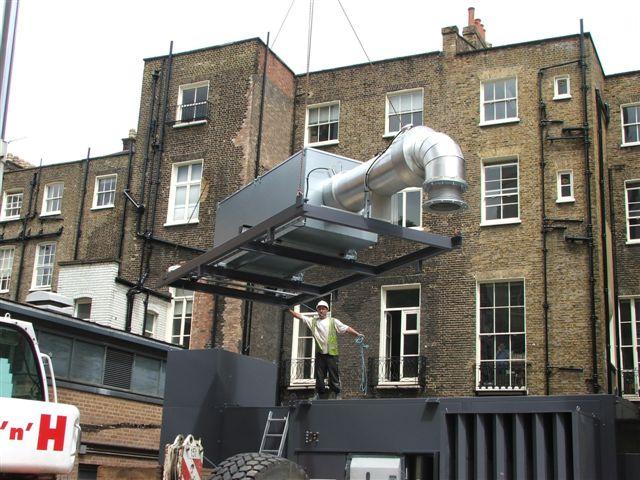
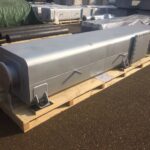
The existing silencer was removed from the generator canopy roof and replaced by the combined SCR pus silencer.
The recommendation was to use no more than 50ppm ULSD Fuels to minimise any increase in particulates.
There was no stated requirement for the reductions in particulate, although it was not expected that we would increase PM as a result of introducing the SCR Technology.
Opacity measurements were taken following installation and it was found that there was no significant difference in the PM measurements mainly due to switching to the ULSD.
The specification called for reductions in CO (Carbon Monoxides) from 650mg/Nm3 to no more than 156mg/Nm3 and HC (Hydrocarbons) from 150mg/Nm3 to no more than 36mg/Nm3.
The actual CO results measured after the abatement was fitted was 130mg/Nm3 (reduction of -80%) and HC 30MG/Nm3 (again a reduction of -80%).
This was achieved by using a DOC catalyst up front to the SCR Substrates
The measured NOx levels on this engine prior to fitment of the IMS SCR Abatement Technology was 3500mg/m3N @ 5% O2 which was needed to be reduced to a maximum of 700mg/m3N @ 5% O2, a reduction factor of 80%.
The SCR system was designed to provide a reduction of a minimum of at least -85%, however when commissioned the actual NOx emissions were shown to be around 350mg/m3N @ 5% O2 which equates to a 90% reduction in NOx.
An AdBlue Tank of approximately 120 Ltr capacity was supplied together with transfer pipework which was suitable for a run-time of approximately 30 hrs at full load. Due to space restrictions a larger tank could not be installed, and the urea supplier had to guarantee to top up within 24 hours.
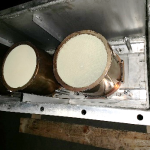
The SCR Substrates used were rectangular in shape fitted in a number of banks in series. Since supplying this type of system IMS have switched to using round substrates in a modular construction all in parallel which reduces the overall backpressure across the system.
This unit also had an external AdBlue Mixing Pipe which increases the length of the system. IMS now wherever possible uses an embedded mixer pipe with the reactor.
Also, the reactor used an air assisted AdBlue Injector which required a compressor to deliver the AdBlue and keep the injector cool.
Today, IMS uses an airless AdBlue injection system where the injector is cooled by recirculating the AdBlue across the injector.
We also now use both “Engine Out” and “Tailpipe” NOx Sensors (rather than a single NOx sensor on the outlet) as part of a closed loop system which continually monitors NOx reductions across the SCR Catalysts.
The complete system was delivered, installed and commissioned by IMS.