


What is an SCR System?
An SCR system (Selective Catalytic Reduction system) is an advanced emissions control technology used to reduce nitrogen oxides (NOx) in the exhaust of diesel and gas-powered engines.
SCR systems are widely used in power generation, industrial applications, and marine engines to meet strict environmental regulations, including the Medium Combustion Plant Directive (MCPD) and Stage V emissions standards.
By using a controlled chemical process, an SCR system converts harmful NOx emissions into harmless nitrogen and water vapour, significantly improving air quality and ensuring regulatory compliance.
How SCR Systems Work
SCR systems reduce NOx emissions through a four-stage chemical process:
- Dosing: A urea solution (AdBlue) is injected into the exhaust stream.
- Decomposition: At temperatures above ~180°C, urea decomposes into ammonia gas (NH₃).
- Catalytic Reaction: Ammonia reacts with NOx over a catalyst.
- Clean Output: NOx is converted into nitrogen (N₂) and water vapour (H₂O).
Standard SCR Systems vs Airless SCR Systems
Traditional SCR systems rely on compressed air to atomise urea. The IMSeco Airless SCR system removes this requirement by using a high-pressure dosing system, making it more efficient, reliable, and compact particularly for retrofit applications.
IMSeco “Airless” SCR Systems
The IMSeco “Airless SCR (Selective Catalytic Reduction) Technology” is a highly effective and durable Emissions After-Treatment System that provides up to 98% NOx reduction in Diesel- or Gas-Powered Engines. The system is a low-pressure, compact modular design that can be supplied on a framework together with the IMS Acoustic Silencers, along with Urea Tanks, either in a plastic bunded type or a bespoke built metal bunded design.
The systems come with an ECU (Electronic Control Unit) housed within our SCR Control Cabinet along with an array of sensors that constantly measure the exhaust gas volume, temperatures, backpressures and the amount of NOx before and after the SCR Catalysts to determine the exact amount of urea to inject into the exhaust at the appropriate time.
Once injected, the urea will be atomised into an ammonia gas for reaction across the SCR Catalysts to provide the levels of NOx reductions required to meet either the MCPD (Medium Combustion Plant) Directive or Tier 4 (Stage V) NOx Emissions requirement.
Should CO (Carbon Mon-oxides), HC (Hydrocarbons) or PM (Particulate Matter) reductions also be required, the SCR System can be combined with our DOC (Diesel Oxidation Catalysts) and DPFs (Diesel Particulate Filters).

The ECU, as well as determining the exact amount of urea to inject via the ”Airless” injectors, also controls the delivery of urea via a pump/filter from the main Bunded Urea Bulk Tank to our Buffer Tank fitted with a pressure rail that pressurises the urea for injection and atomisation within the exhaust.
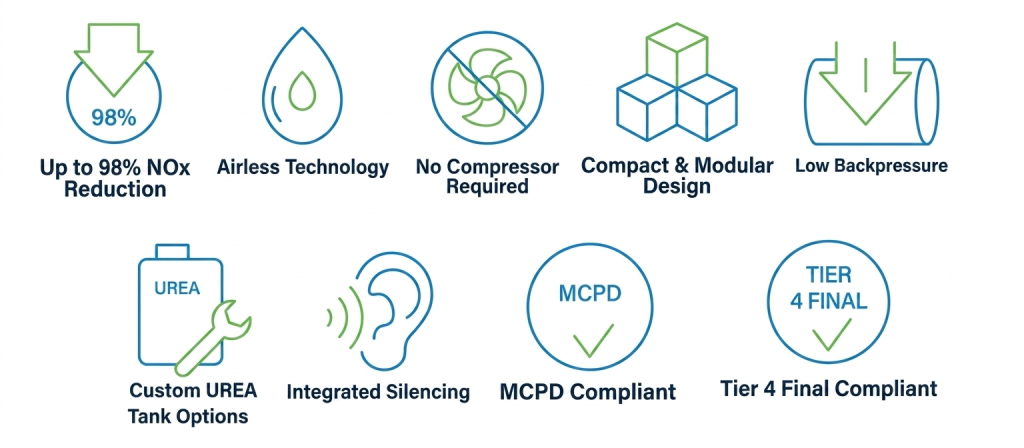
This negates the need for an air compressor in the system. Even the level sensors in the urea tanks we provide are electronically connected to the ECU so that it monitors the urea levels at all times and provides warnings as the levels drop, which can be seen on an LCD Display on the front of our Control Cabinet.


A ModBus Converter can also be supplied within the Control Cabinet if required as a link to the Site BMS system, plus our software allows all parameters to be exported to generate reports. If required, we can also integrate a PC within our cabinet to provide remote support for our system.
The Electronic Control System is powered by a 24V DC supply, so no need for mains power.
IMSeco SCR Technology comprises the following components

- SCR Catalyst
- MAP Sensor (Air Intake Pressure)
- Temperature Sensor
- NOx sensors (Engine Out and Tailpipe)
- ECU
- AdBlue Pump
- AdBlue Injector
- Backpressure Sensor
- AdBlue Day Tank
- Speed Sensor
The IMSeco SCR Reactor
The SCR Catalysts are housed in a full Stainless-Steel Reactor with an embedded Mixer Pipe and a removable lid for access to remove the substrates for maintenance if required. We also supply Ammonia Slip Catalysts (ASC) after our SCR Catalysts as an added precaution to eliminate any possibility of excess ammonia being emitted from the tailpipe.

The IMSeco SCR Technology is capable of achieving up to -98% NOx reductions.
IMSeco SCR System works!
The engine speed and load are used to calculate the exhaust flow across the catalysts to determine the exact rate at which to inject the “AdBlue” agent.
AdBlue is a liquid reductant which consists of approximately 68% water and 32% Urea.
IMSeco provides a small integral “AdBlue Tank” with level sensors and a control panel that controls the amount of AdBlue that is dosed via the “AdBlue Pump” and the “Airless AdBlue Injector”.
Once injected into the exhaust stream the water content of the AdBlue will evaporate, and the urea will decompose into an ammonia gas at temperatures above 180C.
A temperature sensor is used at the point of injection to ensure that there is sufficient temperature for injection to take place to prevent the Liquid Urea crystallising and potentially blocking the face of the SCR.
Once converted into an ammonia gas and passed across the SCR Catalyst a chemical reaction takes place that converts NOx (NO + NO2) into nitrogen (N2) and water vapour, natural components of the air we breathe, which is then expelled through the exhaust outlet.
NOx sensors are used to measure the “Engine Out” and “Tailpipe” NOx to validate NOx reductions that are taking place across the SCR Catalysts.
An ammonia slip catalyst is also used after the SCR Catalysts to prevent any ammonia gas being emitted from the tailpipe in the unlikely event that there is an overdosing of the AdBlue.
The ECU is fitted with a memory chip which stores “Real-Time” NOx emissions data can be downloaded via the Windows Friendly Software to enable reporting of reductions being achieved.
Downloads can be done manually via a laptop or through a Telematics Package.
The IMSeco SCR System when retrofitted to an older Stage II/IIIA engine is capable of bringing the emissions below the threshold limit of 190mg/Nm3 NOx set by DEFRA for compliance with the MCPD (Medium Combustion Plant Directive).
By adding the DPF Technology as well as SCR, a Stage II/IIIA engine can be potentially brought to the latest Stage V emissions equivalence for Mobile Generators.
SCR Systems: High-Efficiency Airless NOx Control
SCR Systems: High-Efficiency Airless NOx Control
IMSeco can now offer MCERT Gas Testing
Under The Environmental Permitting (England and Wales) (Amendment) Regulations 2018, all generators must be registered and obtain a permit, regardless of their use for standby or prime power. This process includes recording the emissions values of the generator.
Generator emissions gas testing is necessary for several reasons:
– All specified generators must undergo permitting to ensure that the generator site does not significantly impact air quality.
– When applying for a permit, it is crucial to include NOx levels to verify they do not exceed 500mg/Nm3 per year (15% O2).
While many gensets come with a datasheet that may contain emissions values, these values can be inaccurate for older models. DEFRA accepts datasheets from engine manufacturers, but older engines may lack this documentation, making gas testing essential. IMS offers both standard gas testing and MCERTS emissions gas testing.
Upon completion of gas testing, IMS will provide a comprehensive written report for submission with your permit.
Key permit conditions to note include:
1. **Standard Emissions Limit Value (ELV)**: According to the MCPD, the standard ELV for nitrogen oxides is 190mg/Nm3, applicable to all generator technologies and fuels. If secondary abatement is needed to lower NOx levels (e.g., SCR), the ELV must be achieved within 20 minutes of starting.
2. **Air Quality Standards**: The specified generator must not breach air quality standards. In areas requiring stricter conditions, such as near schools or hospitals, permits may impose tighter ELVs, enhanced emission dispersion, or reduced operational hours.
3. **No Persistent Dark Smoke Emissions**: Dark emissions, as defined by the Clean Air Act 1993, are those darker than shade 2 of the Ringelmann Chart. Black smoke is classified as smoke darker than shade 4.
Understanding these regulations and testing requirements is essential for compliance and maintaining air quality.

The MCPD was transposed into UK Law in December 2017 setting emission limits for Power Generation Equipment with engines with a thermal rating of between 1 and 50MW that ‘combust’ or burn fuel (such as diesel or gas) in order to produce power.
The directive sets limits for NOx (NO/NO2) of 190mg of NOx / Nm3 (at 15% O2) and 120mg/NM3 for Sulphur Dioxides (SO2).
The limits are to be achieved within 20 minutes of start-up for Tranche A applications and within 10 minutes for Tranche B.
Dates for Compliance
Tranche B
Jan 2019 – Newly installed Plant/Contracts 1MW to 50MW
Tranche A
Dec 2024 – Existing Plant between 5 MW to 50MW
Dec 2029 – Existing Plant between 1 MW to 5MW
Operations that are definetely affected
STOR (Short Term Operating Reserve) projects to the National Grid
Engines that operate/used for the Capacity Market Contracts
MCPD Exemptions
Backup Generators which are tested up to 50 hrs/PA
(Note: These will need to comply if they are in an AQMA with High Background NOx and run for more than 50hrs/PA)
Generators with Safety Roles in Nuclear Sites
Triad Programs used to reduce load on National Grid
(Note these are likely to be affected in the near future)
MCPD covers England & Wales. (A seperate process is being carried out by Scotland & Northern Ireland)
Operators must obtain an environmental permit to operate plant.
Monitoring of the MCPD is the responsibility of the Environmental Agency.
Contact Us
Fill out a few details and we will get back to you.


