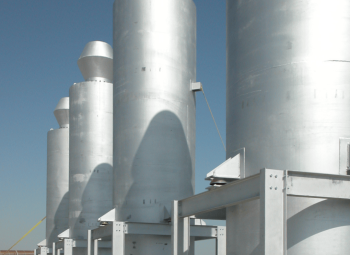
Big news for generator operators and site managers across the UK: IMSeco can now offer full MCERT emissions gas testing. That means you can get your silencer, your exhaust system, and your compliant emissions testing sorted in one place.
But why does this matter? And what exactly do you need to do to stay compliant under current UK regulations? Let’s break it down.
Why Does Every Generator Now Need a Permit?
Under the Environmental Permitting (England and Wales) (Amendment) Regulations 2018, all specified generators must be registered and obtain an environmental permit — regardless of whether they’re used for standby or prime power. There’s no exemption for backup generators sitting idle in a car park. If it’s a specified generator, it needs a permit.
Part of that permitting process involves recording the emissions values of the generator. Specifically, you need to demonstrate that your NOx levels don’t exceed 500mg/Nm3 per year (measured at 15% O2). That’s a hard limit — and getting it wrong means enforcement action from the Environment Agency.
What is MCERT Gas Testing — and When Do You Need It?
MCERT stands for Monitoring Certification Scheme. It’s a UK government-backed programme that accredits the organisations and equipment used to carry out emissions testing on industrial plants. Results from MCERT-accredited testing are accepted by the Environment Agency (EA) and Natural Resources Wales as legally valid evidence for permit applications and renewals.
Many generators come with a manufacturer’s datasheet that includes emissions values. DEFRA does accept these — but here’s the catch: older engines may not have up-to-date documentation, and the values on older datasheets can be inaccurate. If your generator is ageing or lacks reliable paperwork, gas testing is the only way to get figures that regulators will actually trust.
IMS offers both standard gas testing and full MCERTS emissions gas testing. On completion, you receive a comprehensive written report, ready for submission with your permit application.
Key Permit Conditions You Need to Know
It’s worth understanding exactly what your permit is measuring you against. Three main conditions apply to most generator sites:
- Standard Emission Limit Value (ELV) for NOx
The Medium Combustion Plant Directive (MCPD) sets the standard ELV for nitrogen oxides at 190mg/Nm3. This applies across all generator technologies and fuel types. If your NOx output is above this threshold and you need secondary abatement — for example, a Selective Catalytic Reduction (SCR) system — that equipment must bring emissions within the ELV within 20 minutes of the engine starting.
- Air Quality Standards
Your generator must not breach local air quality standards. In sensitive locations — near schools, hospitals, or residential areas — the EA may impose tighter ELVs, require enhanced emission dispersion modelling, or restrict your operational hours. If you’re unsure how your site will be assessed, it’s worth taking professional advice before applying.
- No Persistent Dark Smoke Emissions
Under the Clean Air Act 1993, dark smoke is defined as emissions darker than shade 2 of the Ringelmann Chart. Black smoke — darker than shade 4 — is a clear breach. Persistent visible smoke is not just a permit issue; it’s a sign of poor combustion and usually points to a maintenance or fuel quality problem that needs addressing before testing.
How IMSeco Supports Your Compliance Journey
IMSeco is a specialist range of industrial exhaust silencers and acoustic systems built for diesel engines, gas engines, and turbines. We’ve been supplying and installing these systems across the UK for decades — in power generation, data centres, healthcare, construction, and more.
Now that IMSeco also offers MCERT gas testing, the compliance process becomes much simpler for our customers. Here’s how it typically works:
Step 1 — We carry out MCERT gas testing on your generator and produce a formal written report.
Step 2 — If your NOx or other emissions are borderline or non-compliant, we review your exhaust configuration. A poorly specified silencer can increase backpressure, worsen combustion efficiency, and push emissions higher than they need to be.
Step 3 — We specify and install the right IMSeco silencer for your engine, matched to your exhaust parameters and site conditions.
Step 4 — A follow-up test confirms compliance, and you submit the report with your permit application.
Having one team handle both the testing and the exhaust system means no finger-pointing between contractors — and a faster route to a compliant permit.
Do I need a permit for my standby generator?
Yes. All specified generators, including emergency backup units, require registration and a permit under the 2018 Environmental Permitting Regulations.
Can I use the manufacturer’s datasheet instead of gas testing?
Yes, for newer engines. Older engines with incomplete documentation require MCERT gas testing for compliance.
What is the NOx limit for UK generator permits?
Permit applications: ≤500mg/Nm³ (15% O₂). Operational ELV under MCPD: 190mg/Nm³. Sensitive sites may have stricter limits.
What does IMS provide after gas testing?
A detailed report of emissions values, ready for Environmental Permit submission.
What if my generator produces dark smoke?
Dark smoke (darker than shade 2 on the Ringelmann Chart) is a permit breach. Usually caused by fuel, timing, or engine issues, which must be fixed before testing.
Ready to get your generator permitted and your emissions tested? IMS now offers both MCERT gas testing and IMSeco exhaust silencer supply and installation — all under one roof.
Contact Industrial and Marine Silencers Ltd to find out how we can help you stay compliant.