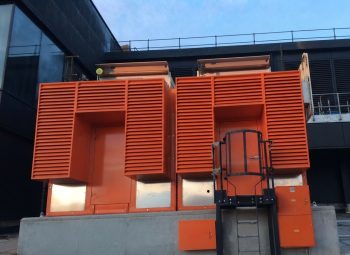
Diesel engines remain essential across data centres, power generation, industrial facilities, marine applications and critical standby power systems. Their reliability and ability to deliver large amounts of power make them difficult to replace in many applications.
However, diesel combustion also produces nitrogen oxides (NOx) pollutants that are increasingly subject to stringent emissions limits.
One of the most effective technologies for controlling these emissions is Selective Catalytic Reduction (SCR).
Modern SCR systems can dramatically reduce the concentration of NOx leaving an engine without interfering with the combustion process itself. IMSeco Airless SCR technology, for example, is designed to achieve NOx reductions of up to 98% under appropriate operating conditions.
Why Do Diesel Engines Produce NOx?
A diesel engine operates by compressing air inside the cylinder before fuel is injected. The resulting combustion process takes place at extremely high temperatures.
These high combustion temperatures cause nitrogen and oxygen present in the intake air to react, producing nitrogen oxides, principally nitric oxide (NO) and nitrogen dioxide (NO₂).
Rather than attempting to remove NOx during combustion, SCR is an exhaust after-treatment technology. It treats the gases after they leave the engine but before they are discharged to the atmosphere.
So, How Does SCR Actually Remove NOx?
The process can essentially be broken down into four stages:
Diesel Engine → AdBlue Injection → Ammonia Formation → SCR Catalyst → Nitrogen + Water
The chemistry sounds complicated, but the principle is relatively straightforward.
- The Engine Produces NOx
Exhaust gas leaves the diesel engine containing NOx alongside the other products of combustion.
Before entering the SCR catalyst, sensors and the system’s Electronic Control Unit (ECU) establish the engine’s operating conditions.
With the IMSeco system, engine speed and load are used to calculate exhaust flow through the catalyst. Sensors monitor parameters including exhaust temperature, backpressure and NOx concentrations, allowing the ECU to determine how much reductant needs to be introduced.
- AdBlue Is Injected into the Exhaust
The next stage is the controlled injection of AdBlue, a urea-and-water solution, into the hot exhaust gas.
This isn’t simply a case of injecting a fixed quantity whenever the engine runs.
Correct dosing is critical.
Too little AdBlue and there may not be sufficient ammonia available to achieve the required NOx reduction. Too much can increase the possibility of unreacted ammonia passing through the system.
The ECU therefore continually calculates the required dosing rate according to the engine’s operating conditions.
In an IMSeco Airless SCR System, a pump and pressure rail pressurise the AdBlue before it is introduced through the Airless injector. This eliminates the requirement for the compressed-air system traditionally used to assist atomisation.
- AdBlue Is Converted into Ammonia
This is where temperature becomes particularly important.
Once the AdBlue enters the hot exhaust stream, its water content evaporates and the urea decomposes to ultimately form ammonia (NH₃).
For the IMSeco system, injection takes place when sufficient exhaust temperature is available, with the website identifying approximately 180°C and above for the decomposition process. A temperature sensor at the injection point helps prevent dosing when conditions are unsuitable, reducing the risk of liquid urea crystallising and potentially obstructing the SCR system.
The ammonia produced from the AdBlue now becomes the active reducing agent required for the next stage.
- The Chemical Reaction Takes Place Inside the SCR Catalyst
The exhaust gas and ammonia mixture passes through the SCR catalyst.
Inside the catalyst, ammonia reacts selectively with the NOx in the exhaust.
Rather than simply trapping the NOx, the chemical reaction converts it into nitrogen (N₂) and water vapour (H₂O).
These are then discharged through the exhaust outlet.
This is the fundamental principle behind SCR technology:
NOx + Ammonia + Catalyst → Nitrogen + Water
Instead of allowing harmful concentrations of NO and NO₂ to leave the exhaust, the SCR process chemically transforms them into significantly less harmful substances.
Closed-Loop NOx Monitoring
An effective SCR system also needs to know whether the required reduction is actually being achieved.
The IMSeco system therefore uses NOx sensors both before and after the SCR catalyst.
The first measures the engine-out NOx concentration, while the second measures the concentration leaving the SCR system.
Comparing these measurements allows the control system to validate the reduction taking place across the catalyst and adjust the dosing strategy accordingly.
This closed-loop approach is particularly valuable where operators need to demonstrate emissions performance rather than simply assume that the catalyst is functioning correctly.
The ECU can also store real-time emissions information for subsequent reporting, while system parameters can be integrated with a site’s BMS through an optional Modbus interface.
What Happens to Excess Ammonia?
Precise dosing is designed to provide enough ammonia to react with the NOx without introducing unnecessary quantities.
However, additional protection can be provided by an Ammonia Slip Catalyst (ASC) positioned after the main SCR catalyst.
If a small amount of ammonia passes through without reacting — known as ammonia slip — the ASC provides a final treatment stage to minimise ammonia emissions from the tailpipe. IMS incorporates an ASC after its SCR catalysts for this purpose.
Why Use an Airless SCR System?
Traditional SCR installations can use compressed air as part of the urea atomisation process.
Removing this requirement can simplify the overall installation.
The IMSeco Airless SCR System instead uses its pumping and pressure system to deliver and atomise the AdBlue, eliminating the need for an external air compressor.
This can be particularly beneficial for retrofit applications, standby generators and data centre installations, where available space, electrical infrastructure and installation complexity can all be significant considerations.
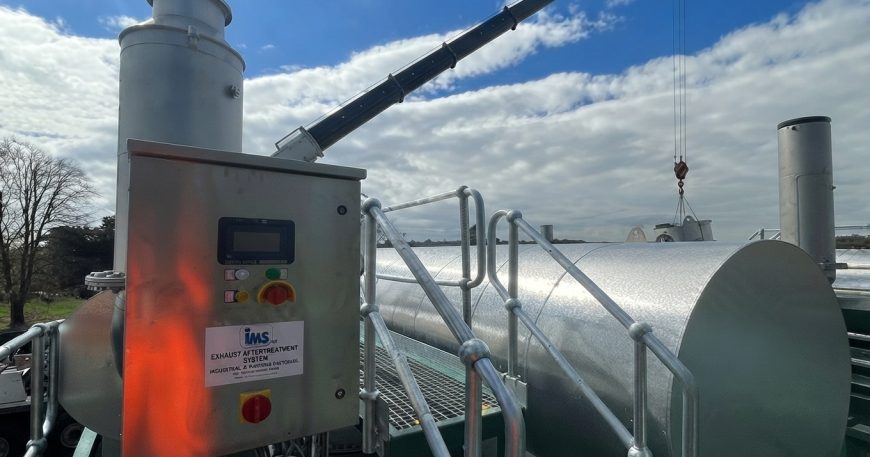
The electronic control system itself operates from a 24V DC supply, while the SCR package can be supplied in a compact modular arrangement incorporating the reactor, control cabinet, dosing equipment, urea storage and associated sensors.
SCR Can Reduce NOx by Up to 98%
When correctly engineered for the engine, exhaust conditions and required emissions target, SCR can achieve extremely high levels of NOx reduction.
IMSeco Airless SCR Technology is capable of reducing NOx emissions by up to 98%.
For operators of diesel generators and industrial engines, this can make the difference between an engine exceeding an emissions limit and achieving the required environmental performance.
SCR can also form part of a wider emissions after-treatment package. Where reductions in carbon monoxide (CO), hydrocarbons (HC) or particulate matter (PM) are required, IMS states that SCR can be combined with technologies including Diesel Oxidation Catalysts (DOC) and Diesel Particulate Filters (DPF).
From NOx to Nitrogen and Water
Ultimately, the effectiveness of SCR comes down to a carefully controlled chemical process.
The engine produces NOx.
↓
AdBlue is precisely injected into the hot exhaust.
↓
The urea decomposes to produce ammonia.
↓
Ammonia and NOx react across the SCR catalyst.
↓
NOx is converted into nitrogen and water vapour.
↓
NOx sensors confirm the reduction achieved.
As diesel generators continue to provide critical standby and prime power for data centres, hospitals, industrial facilities and other essential infrastructure, controlling their environmental impact is becoming increasingly important.
Selective Catalytic Reduction provides a proven way of doing exactly that, allowing operators to retain the reliability and performance of diesel-powered equipment while dramatically reducing its NOx emissions.
Industrial & Marine Silencers Ltd’s IMSeco Airless SCR technology combines controlled AdBlue dosing, real-time monitoring and SCR catalyst technology to provide NOx reductions of up to 98% without the requirement for a compressed-air dosing system.
Cleaner exhaust. Lower NOx. The same dependable power.